Table of Contents
ToggleIf you’ve had a PCOS diagnosis for years, the PCOS name change probably reached you as a confusing headline. PCOS is now called PMOS, short for polyendocrine metabolic ovarian syndrome. Your diagnosis hasn’t changed. The criteria are the same, the treatment is the same, and you don’t need a new appointment or new tests. The name changed because the old one pointed everyone at the wrong part of your body.
What Changed and What Didn't
The PCOS name change is narrower than the coverage makes it sound. Here’s the short version.
What changed:
- The official name is now polyendocrine metabolic ovarian syndrome, or PMOS.
- The framing moved from “an ovary problem” to a whole-body hormonal and metabolic condition.
- Doctors are being pointed toward blood sugar, cholesterol, and blood pressure, not just cycles and fertility.
What didn’t change:
- Your diagnosis. If you had PCOS, you have PMOS. Same condition.
- The criteria used to diagnose it.
- Your treatment, your medications, and your test results.
- What you eat.
This post is about the name itself. For how food fits into managing the condition, my Mediterranean diet for PCOS guide covers the full picture. You’ll find everything else I’ve written on nutrition and specific conditions in the health conditions section.
Why the PCOS Name Change Happened
The rename came out of years of work by doctors, researchers, and patients together. It comes down to one detail that most people with the diagnosis have never been told.
The “Cysts” Were Never Cysts
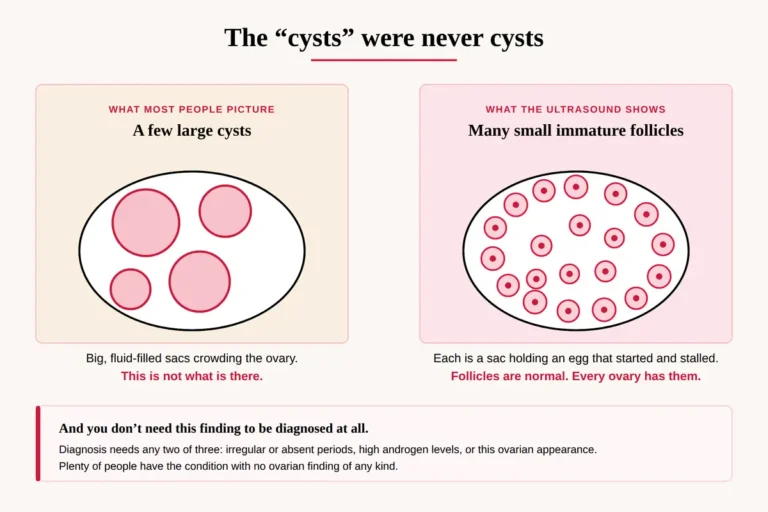
The “cysts” in polycystic ovary syndrome were never cysts.
What shows up on an ultrasound is a higher number of small, immature follicles. A follicle is the tiny fluid-filled sac that holds a developing egg. Every ovary has them. In this condition, more of them start developing and then stall before releasing an egg.
That’s a very different thing from a cyst. When the new name was announced, the Endocrine Society said it plainly: there is no increase in abnormal cysts on the ovary.
And you don’t need that ovarian finding to be diagnosed at all. Diagnosis needs two of three things: irregular or absent periods, high androgen levels, or that ovarian appearance on an ultrasound. Any two of the three. The international guideline is clear that an ultrasound isn’t needed when the first two are both present.
So plenty of people have this condition with no cysts and no ovarian finding of any kind. If nobody ever explained that to you, you’re in good company.
What the Old Name Got Wrong
Names shape what people go looking for. “Polycystic ovary syndrome” told everyone, doctors included, to look at the ovaries.
If you have this condition, you already know it doesn’t feel like an ovary problem. It feels like blood sugar crashes and weight that won’t shift. It feels like hair, skin, mood, and energy. The ovaries are one part of something much bigger.
That mismatch had real consequences. The old name contributed to missed diagnoses and to treatment that didn’t go far enough. When a condition sounds like a reproductive issue, the metabolic side gets less attention than it needs.
What the New Name Points To Instead
Polyendocrine metabolic ovarian syndrome is a mouthful, but every part of it is doing a job. “Polyendocrine” means several hormone systems are involved, not only reproductive ones. “Metabolic” points at blood sugar, insulin, and how your body stores and uses energy. “Ovarian” keeps the ovaries in the picture, as one part of it rather than the whole story.
Most people with this condition have some degree of insulin resistance. Insulin resistance means your cells don’t respond to insulin as well as they should. Your body then makes more of it to keep blood sugar steady. It also shows up at every body size, not only in people carrying extra weight.
That’s why the long-term risks reach well past fertility. Both type 2 diabetes and heart problems are more common than average. Ongoing inflammation is part of the picture as well.
The new name is the medical world catching up to what patients have been describing all along.
What the PCOS Name Change Means for You
Practically speaking, very little. It doesn’t ask anything of you.
Your Diagnosis and Your Records
Your diagnosis stands exactly as it is. There’s nothing to redo, reconfirm, or reapply for.
Your old records will still say PCOS, and that’s fine. Both names will be in use for about three years, until the international guideline is fully updated in 2028. Your doctor may keep saying PCOS for a while. So might your pharmacy, your insurer, and every app on your phone.
Use whichever term you’re comfortable with. Both refer to the same condition.
Your Treatment and Your Tests
Nothing here changes either. Same medications, same doses, same monitoring.
You don’t need a new appointment because of this. If you’re already in treatment, keep following your provider’s plan.
There is one thing worth raising at your next regular visit. Check that your care covers the metabolic side, not only your cycles. The international guideline already recommends:
- A blood sugar test at diagnosis, then every one to three years
- A full cholesterol panel at diagnosis
- Blood pressure once a year
If your appointments have only ever looked at your periods, that’s a fair thing to bring up.

What a New Name Can't Fix
The new name is a real improvement. It’s also worth being honest about what it doesn’t do.
A better name doesn’t shorten anyone’s wait for a diagnosis by itself. Those waits have been long for a long time. Around a third of women wait more than two years for an answer. Nearly half see three or more doctors before they get one. More than half come away with no information about long-term complications at all. A new name doesn’t undo any of that.
Treatment options are also the same today as they were last year. Nothing new became available in May. The rename changes what doctors are pointed toward, not what they can offer you.
The transition will be a little messy too. For the next few years you’ll see both names, sometimes in the same clinic on the same day. That’s inconvenient rather than worrying, but it helps to expect it.
What to Eat Hasn't Changed Either
Nothing about the PCOS name change affects how you should eat. Same foods, same principles.
If you’ve read this site before, the metabolic framing won’t be new to you. My PCOS guide has always led with insulin resistance and inflammation rather than cysts. I’m also currently working as a researcher on a large nutrition and PCOS study. That means a lot of time spent on the metabolic side of this condition. The name has simply caught up.
One honest note: there isn’t one official diet for this condition, and the international guideline says as much. What it does set are targets. Steadier blood sugar, healthier cholesterol, blood pressure in a good range, and weight that stays stable over time. A Mediterranean-style pattern is a well-supported and sustainable way to work toward those, which is why I keep coming back to it.
For the practical version, start with why the Mediterranean diet works so well for PCOS weight loss. From there, look at the foods worth building your meals around and what a Mediterranean breakfast for PCOS actually looks like.
F.A.Q.
Yes. Same condition, different name. The PCOS name change was about the wording, not the diagnosis, so nothing about your condition or your care is different.
Polyendocrine metabolic ovarian syndrome. “Polyendocrine” means several hormone systems are involved. “Metabolic” points at blood sugar and insulin. “Ovarian” keeps the ovaries in the picture as one part of it.
Because the old name pointed at the wrong thing. What shows up on an ultrasound is a higher number of immature follicles, not cysts. You can also be diagnosed without any ovarian finding at all. The old name framed a whole-body condition as a localized ovary problem.
No. It doesn’t require a new appointment, new tests, or a new diagnosis. At your next regular visit, it’s reasonable to ask whether your care covers blood sugar, cholesterol, and blood pressure alongside your cycles.
No. The rename doesn’t alter the foods that support this condition. If you’re weighing up approaches, Mediterranean diet vs. low-carb for PCOS compares the two most common ones.

Nour is a registered dietitian, nutrition researcher, and founder of MedDietMindset. With a passion for evidence-based nutrition, she specializes in Mediterranean diet strategies, PCOS management, and sustainable weight loss. Nour is dedicated to transforming complex scientific research into clear, actionable guidance to support healthier, long-lasting lifestyle changes. Through her blog, she empowers readers to build habits that prioritize well-being, balance, and vitality.